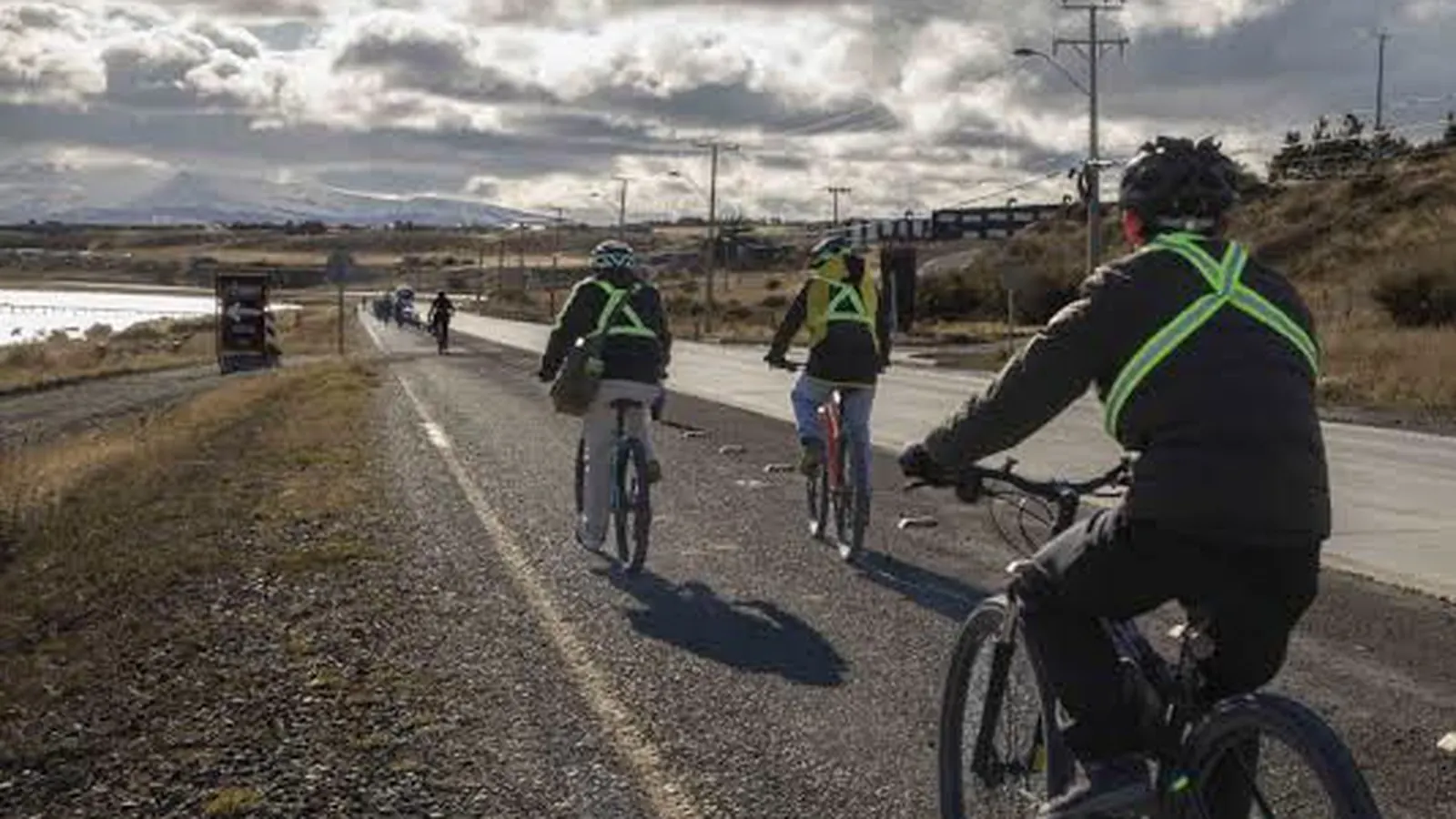
Cycling around Puerto Natales starts with verification, not a downloaded line. Confirm that every segment uses an authorised road, check current conditions through Chile’s Roads Directorate, review the official forecast and equip the bicycle for Chilean law. This guide does not promise bike lanes, smooth gravel, rentals or universal difficulty ratings.
Build the route from current information
Break the ride into segments and identify the responsible authority. The Ministry of Public Works Roads Directorate is the reference for public road networks and condition enquiries. Within a protected area, ask CONAF whether cycling is permitted. Private roads require permission.
A user track proves that one person recorded a ride; it does not prove current access. Check the recording date, surface, roadworks, bridges, traffic and turnaround options. Remove any segment that cannot be verified.
We do not publish named circuits because no current official source was found that combines access, road condition and measured difficulty for specific routes around Puerto Natales.
Understand Chilean cycling requirements
CONASET explains the Road Coexistence Law and related rules. A cycle needs effective brakes, an audible warning device, lights and reflective elements under the regulated conditions. A helmet is mandatory in urban areas; wearing one throughout the ride is the sensible baseline for visitors.
Use a cycle lane where one exists and follow the road rules where it does not. Do not assume Puerto Natales has a continuous protected network. On pedestrian space, dismount whenever law or safety requires it.
Carry tools you know how to use, a compatible repair system, water, food, layers and battery. Equipment cannot compensate for an unverified route.
Replace difficulty labels with components
Assess total distance, elevation, surface, wind exposure, traffic, self-sufficiency and exit options. The same distance can feel moderate on pavement and demanding on loose gravel. An out-and-back ride also requires enough energy and daylight for the return.
Check the DMC forecast shortly before departure. A climate average is not a forecast, and a helpful outward wind may become a difficult return. Set a turnaround time before starting.
What few cycling guides mention
The critical problem may be logistics rather than fitness: a mechanical issue outside coverage, no confirmed water or a road without usable shoulder. Share the itinerary and do not depend on an informal rescue.
Before renting, verify availability, size, brakes, lights, repair kit, assistance and return conditions directly with the provider. No current rental inventory was verified. The official Natales Transfer website, accessed on 2026-08-01, publishes transfer services but no bicycle transport policy; ask the operator directly rather than assuming bicycles are accepted.
Complete a short test ride before the main route. Check braking, shifting, tyre condition, saddle adjustment and how luggage affects balance. Learn how the wheel or repair system works before leaving town. A bicycle that feels acceptable on a flat street may reveal fit or control problems once the surface changes.
Summary
- Verify management, legality and current condition for every segment.
- Use Vialidad, CONASET, DMC and CONAF as applicable.
- Do not assume bike lanes, shoulders, rentals or app difficulty labels.
- Carry compliant equipment, repair capacity and a return plan.
- Turn back when wind, visibility, surface or energy changes.
Related reading
- Preparing for Patagonian weather
- Viewpoints around Puerto Natales
- Getting to and around Puerto Natales
Rest before choosing the route
Estepa Patagónica can be a base for reviewing the ride, keeping an alternative plan and recovering afterwards. Check availability through the official website or its official WhatsApp. Confirm any bicycle storage or service requirement directly before booking.